Turningpoint
Youth Offender Rehabilitation in 2040
Oct 2024 - Feb 2025
PARTNERSHIP
Ministry of Justice, UK
Role
Service Designer
Service????
Royal College of Art
(FW 02) — ABOUT
Architecture that stands for
clarity and purpose.
Fieldwork is an architecture firm defined by a minimal yet human-centered philosophy. Guided by decades of collective expertise, our team approaches every project with rigor, precision, and creativity. We believe architecture should not chase trends but instead embody clarity, restraint, and long-lasting value.
Our practice spans across scales and disciplines, from residential and commercial architecture to cultural institutions and urban design. By blending technical expertise with cultural awareness, we create environments that respect context, enhance functionality, and inspire those who experience them.
20+
Years of experience
Designing spaces that combine function and beauty.
100+
Completed projects
Across residential, commercial, and cultural sectors.
85%
Repeat clients
Reflecting long-term trust and lasting relationships.
12
Countries served
Delivering projects with global reach and local sensitivity.
Project Overview
Reimagining youth rehabilitation in 2040 through ethical AI, stability support, and system change.
This project explores how a future system could support young offenders in ways today’s structures struggle to achieve.
Partnering with the Ministry of Justice, this project explores the future of youth rehabilitation by 2040, considering the impacts of digital surveillance, social isolation, and institutional strain on youth vulnerability. By applying foresight methods and mapping stakeholder systems, I identified structural gaps and resilient intervention points.
The proposed early-intervention model combines stability support, ethical AI reflection tools, and community reintegration strategies. This work guides policy readiness, strengthens cross-agency collaboration, and outlines a future service ecosystem aimed at reducing reoffending rates.
Problem Framing
Most young people imprisoned by age 24
first offended before 16
Youth Justice Board & Ministry of Justice, 2024
Once in the justice system, they often encounter stigma, fragmented support, and a lack of trusted relationships. Each of these factors statistically increases their chances of reoffending.
(01)
Current Journey
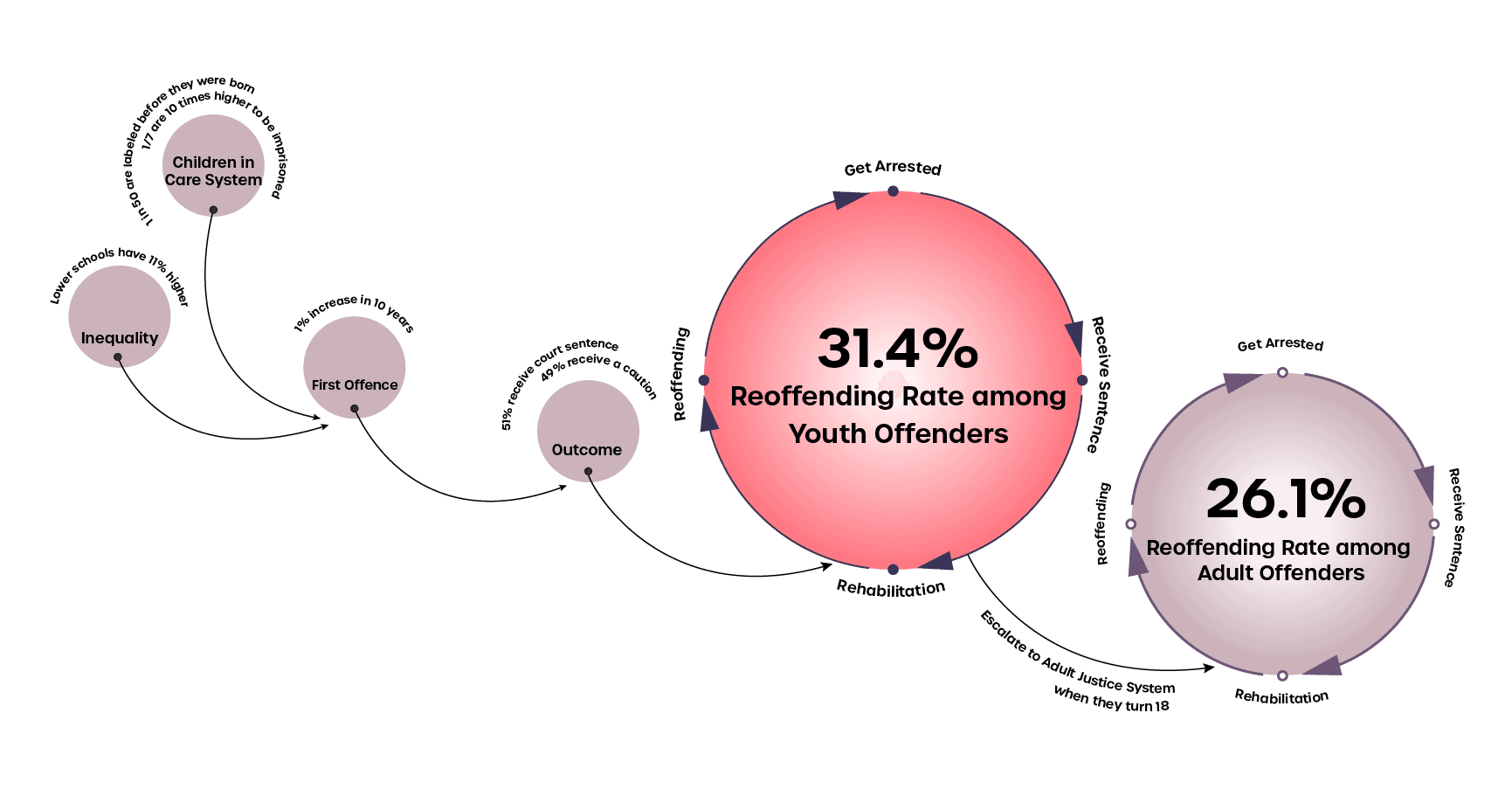
Structural inequality and late intervention in youth justice frequently keep young people reoffending instead of rehabilitating.
(02)
Stakeholder Map
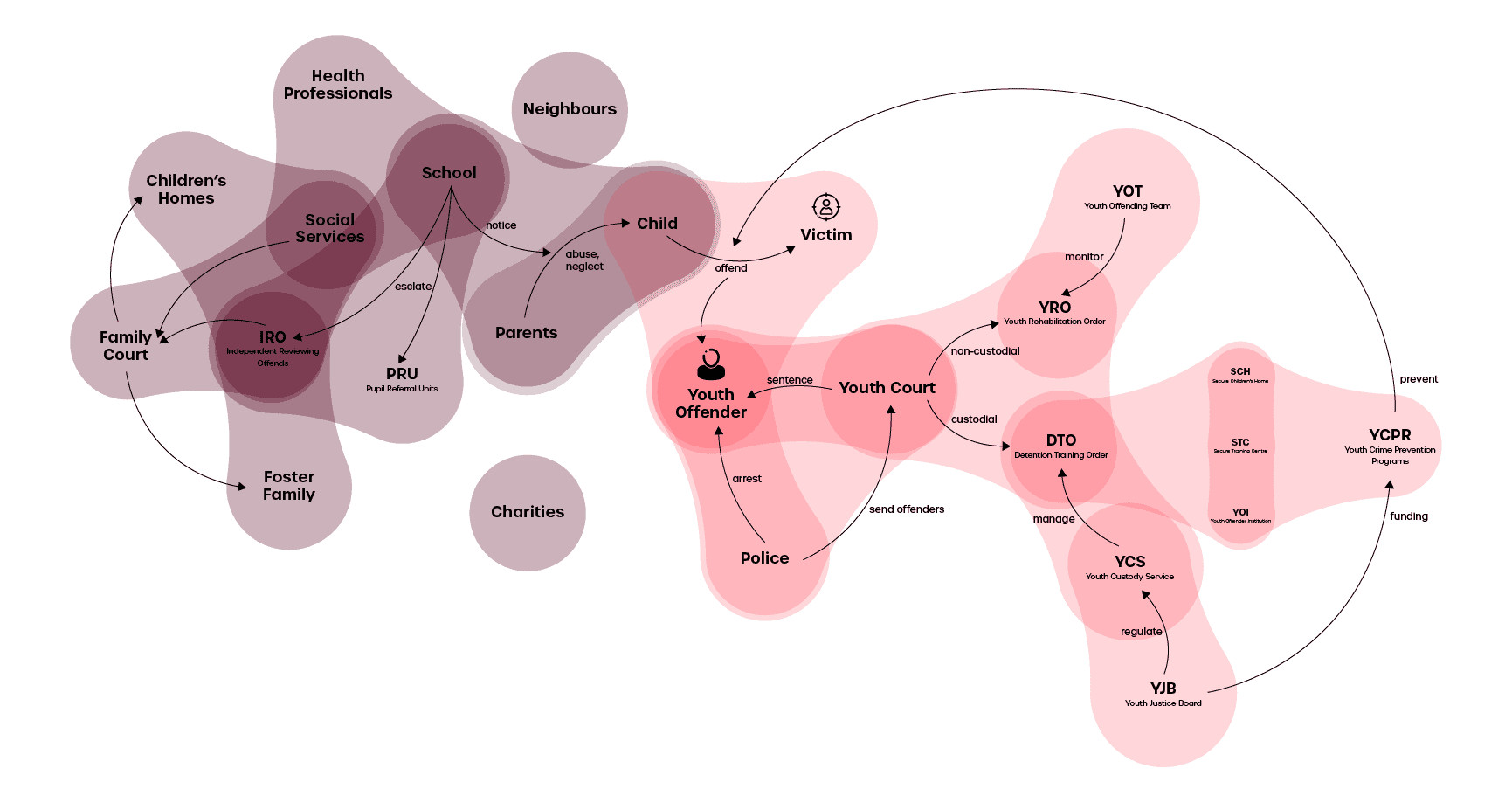
A fragmented ecosystem where agencies operate in silos, causing duplication, unclear roles, and critical support gaps for youth.
Problem Defining
This is not simply a behavioural issue
It is a systemic failure to support vulnerable young people at the moment when they need stability and relational care the most.
Problem Statement
Entering the justice system traps young people
in a vicious cycle of stigma and mistrust, making reintegration difficult.
By 2040, these challenges are expected to intensify due to:
Our Approach
Given the project’s future horizon and complexity,
we applied a product-strategy lens to speculative and service design tools.
We focused on four questions:
(01)
What long-term societal changes will shape future youth behaviour and vulnerabilities?
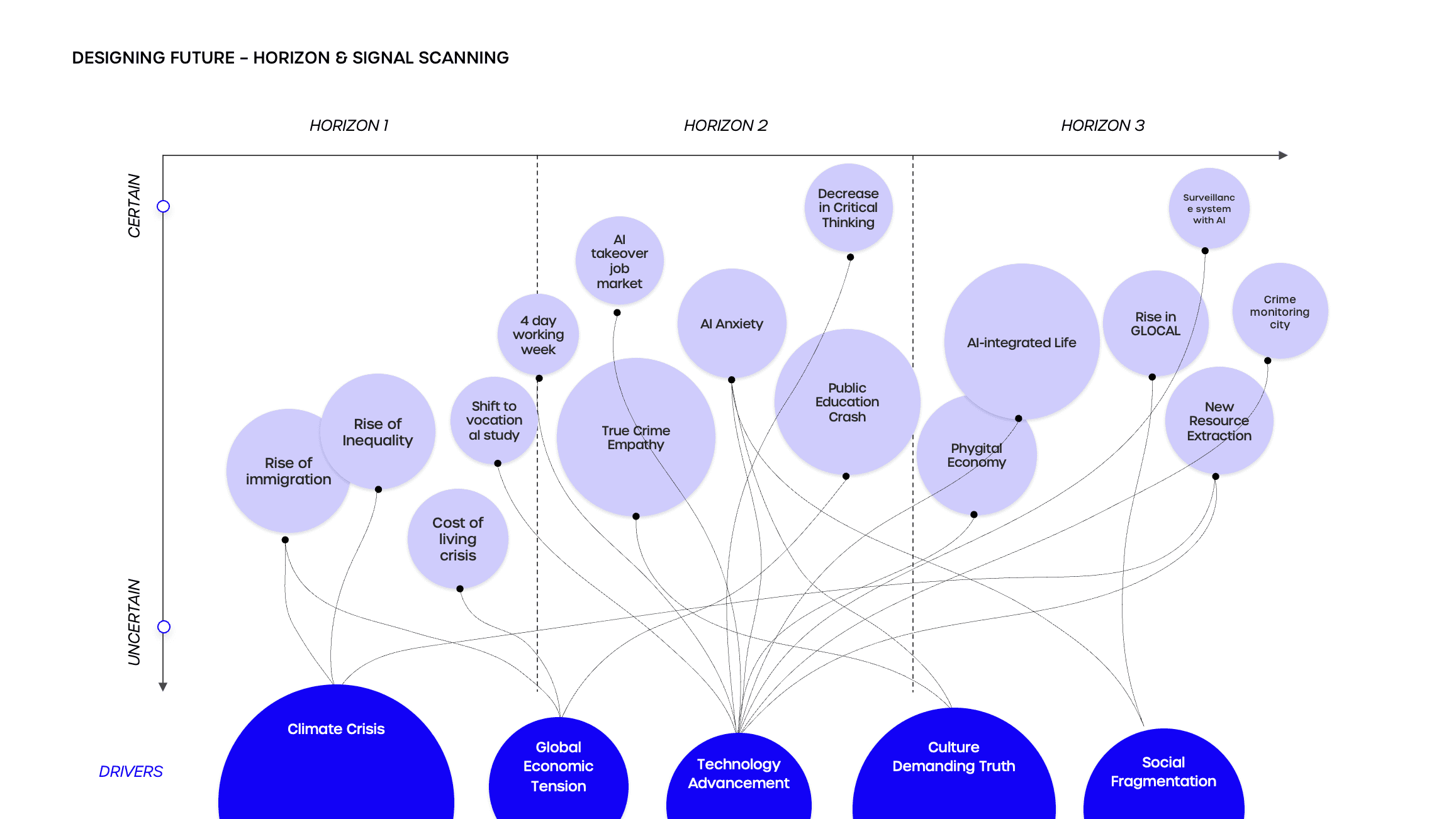
Horizon Scanning, Three Horizons
(02)
How will these shifts change the needs, risks, and motivations of young offenders?
Future Personas, Future Scenario
(03)
What early-intervention opportunities remain resilient across multiple futures?
Opportunity Mapping, Causal Loop Analysis
(04)
What strategic options could guide MoJ’s long-term planning?
Backcasting, Decision Frameworks
Speculative Service Design
Future Scenario
This project explores how a future system could support young offenders in ways today’s structures struggle to achieve.
By 2040, these challenges are expected to intensify due to:
Project Overview
Reimagining youth rehabilitation in 2040
through ethical AI, stability support, and system change.
Partnering with the Ministry of Justice, this project explores the future of youth rehabilitation by 2040, considering the impacts of digital surveillance, social isolation, and institutional strain on youth vulnerability. By applying speculative design methods and mapping stakeholder systems, I identified structural gaps and resilient intervention points. The proposed early-intervention model combines stability support, ethical AI reflection tools, and community reintegration strategies. This work guides policy readiness, strengthens cross-agency collaboration, and outlines a future service ecosystem aimed at reducing reoffending rates.
99%
Prisons Operating Capacity
MoJ prison population projections statistics (2024 to 2029)
£18.1 bn
Re-offending Cost
MoJ economic and social reoffending costs 2019
99%
Prisons Operating Capacity
MoJ prison population projections statistics (2024 to 2029)
£18.1 bn
Re-offending Cost
MoJ economic and social reoffending costs 2019
26.1%
Re-offending Rate among Adult Offenders
Government statistics adult reoffending rate 2023
31.4%
Re-offending Rate among Youth Offenders
Government statistics adult reoffending rate 2023
(FW 05) — CLIENTS
We build trust through relationships as lasting as our spaces.
Our clients range from developers to cultural institutions and private homeowners. Each partnership is grounded in clear communication, professional rigor, and a shared belief in design that stands the test of time.
Sarah Mitchell
“Fieldwork guided our project with remarkable clarity and vision. Their team understood not only the architecture but also the business goals behind it, making them an invaluable partner.”
Director, Horizon Development Group
David Romero
“Working with Fieldwork was seamless from start to finish. Their approach is refined, precise, and deeply thoughtful—our institution now has a space that truly embodies its mission.”
Founder, Romero & Associates Cultural Projects
Join us in shaping spaces that define the future.
(FW 03) — CAREERS
Behind every project is a team of architects, designers, and strategists who bring clarity, rigor, and vision to the work we do. With decades of combined experience, our team thrives on collaboration — blending expertise across disciplines to create spaces that are thoughtful, functional, and built to last.
Project Overview
Reimagining youth rehabilitation in 2040
through ethical AI, stability support, and system change.
This project explores how a future system could support young offenders
in ways today’s structures struggle to achieve.
Partnering with the Ministry of Justice, this project explores the future of youth rehabilitation by 2040, considering the impacts of digital surveillance, social isolation, and institutional strain on youth vulnerability. By applying foresight methods and mapping stakeholder systems, I identified structural gaps and resilient intervention points. The proposed early-intervention model combines stability support, ethical AI reflection tools, and community reintegration strategies. This work guides policy readiness, strengthens cross-agency collaboration, and outlines a future service ecosystem aimed at reducing reoffending rates.
Master question to answer
What could the prison and probation rehabilitation services look like in 2040
a world that has been radically transformed by technological, societal and global changes?
Desirable outcomes to achieve
Speculative visions of a rehabilitation service eco-system
that is adaptive, effective, and aligned with the values and needs of a future society, and the critical needs of identified users.