Problem Framing
Service Strategy
Canvas Designing
PNT Resilience for Local Services
Help local authorities identify PNT dependencies and understand their impact on service delivery.
• Reframed a technical resilience challenge around local service delivery
• Translated specialist PNT guidance into accessible screening and facilitation tools
• Defined how local evidence could feed into existing resilience structures
DESIGN AT
Satellite Applications Catapult
DURATION
2026
ROLE
Service Design Intern
SHARED WITH
National PNT Office & DESNZ

What is GNSS/PNT?
GNSS: Global Navigation Satellite System
PNT: Position, Navigation and Timing
PNT is location and time data broadcast by GNSS (GPS) satellites. It sets traffic signal timing, routes ambulances, and synchronises emergency alerts, mostly invisibly.
A 5-day GNSS outage is estimated to cost the UK £5.2bn,
yet no research maps who actually bears that loss.
London Economics (2017) quantified the cost to transport and emergency services; the impact on residents and local services remains unmapped.
Challenges
• Invisible Dependency
A local service's dependency on PNT is hidden, and stays invisible until something breaks.
• No Awareness
Local authorities have little to no awareness of their own PNT dependency.
• Tech-Heavy Checklist
The existing PNT Resilience Checklist is tech-heavy, built for specialists rather than the officers who actually need it.
Research Findings
To make PNT matter to local authorities,
I first needed to understand what local authorities already prioritised.
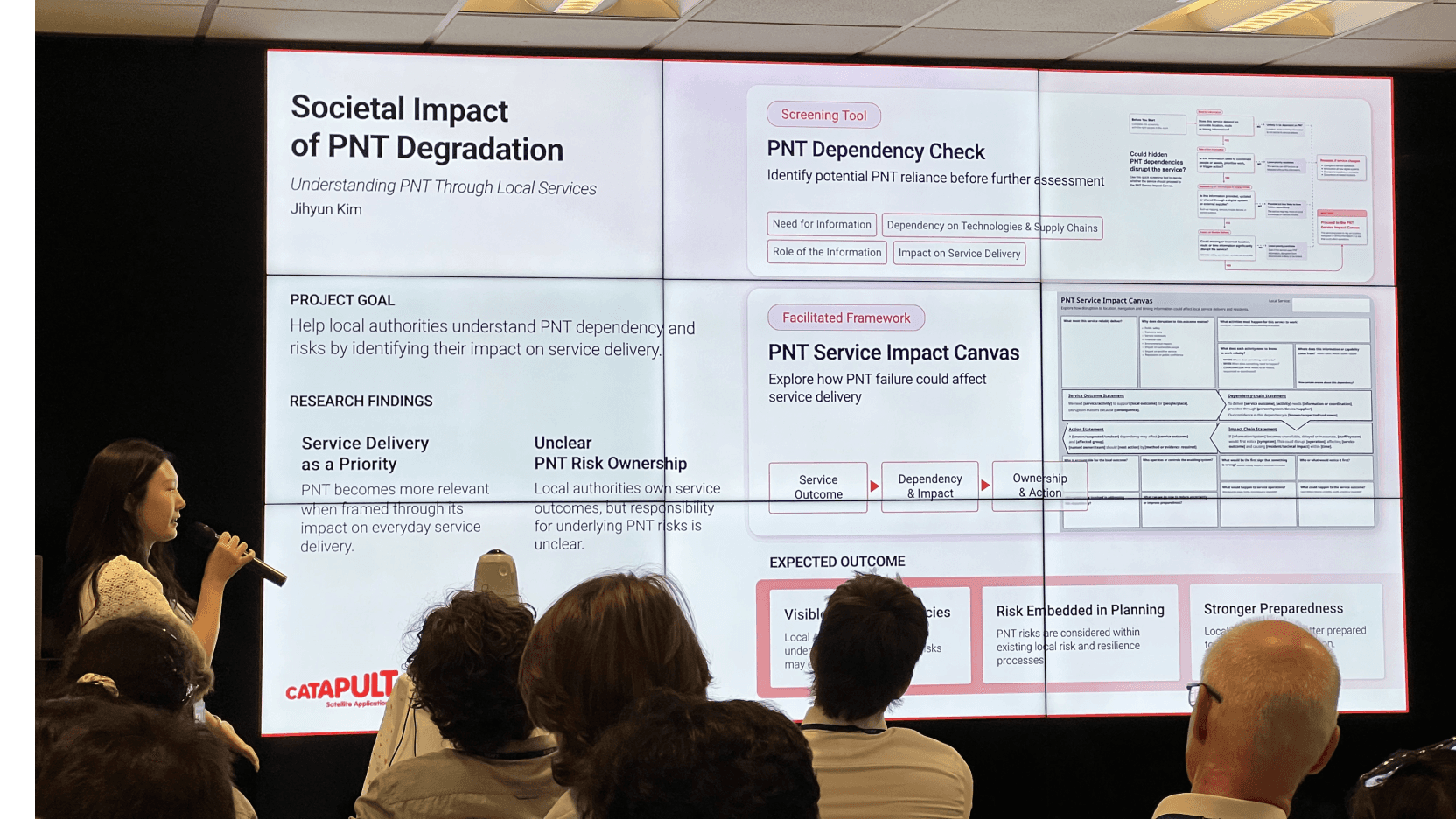
An internal impact-mapping workshop and three local authority interviews surfaced their priorities and blind spots.

01
Service Delivery as a Priority
PNT becomes more relevant when framed through its impact on everyday service delivery.
“In terms of time and budget,
we’ve got to deliver these services day in and day out.”
- Interview from council stakeholder

02
Unclear PNT Risk Ownership
Local authorities own service outcomes, but responsibility for underlying PNT risks is unclear.
“We have a legal duty in many cases…
as an organisation [we] have to deliver these services.”
- Interview from council stakeholder
What this changed
This reframed the challenge
from “How might local authorities assess PNT resilience?”
to “How might we make PNT matter through services local authorities care about?”
Design and Delivery Approach
Before local authorities can move to a detailed technical assessment, they first need a way to identify their own PNT dependencies.
The original hypothesis:
If local authorities can map the societal impact of the PNT failure,
then they might include PNT loss in their risk response plan and prepare for potential PNT degradation.
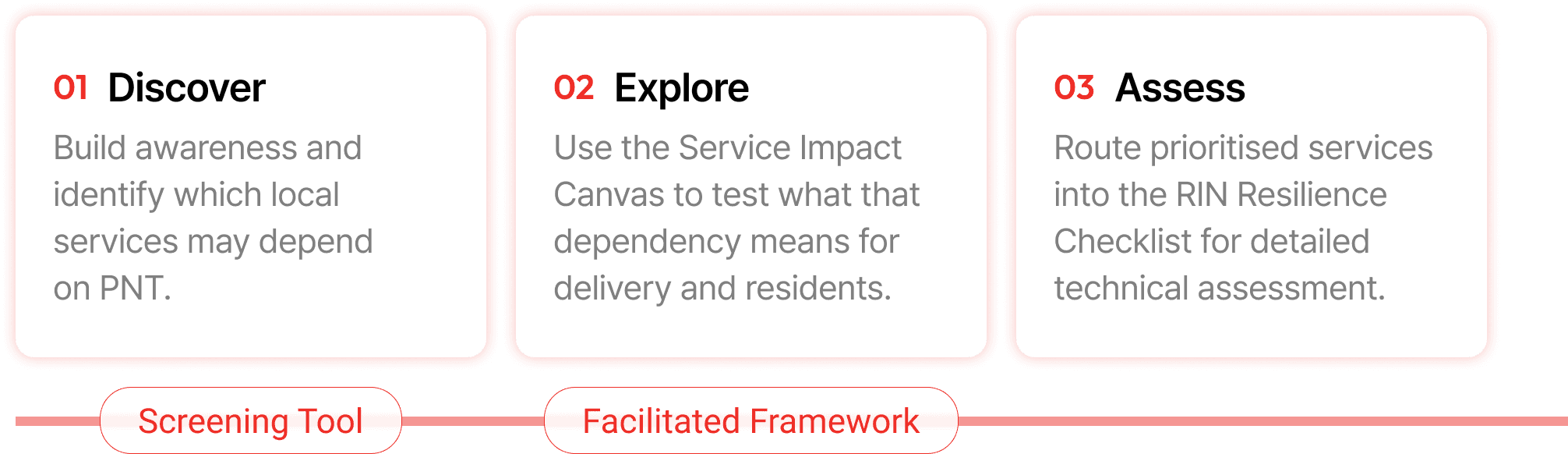
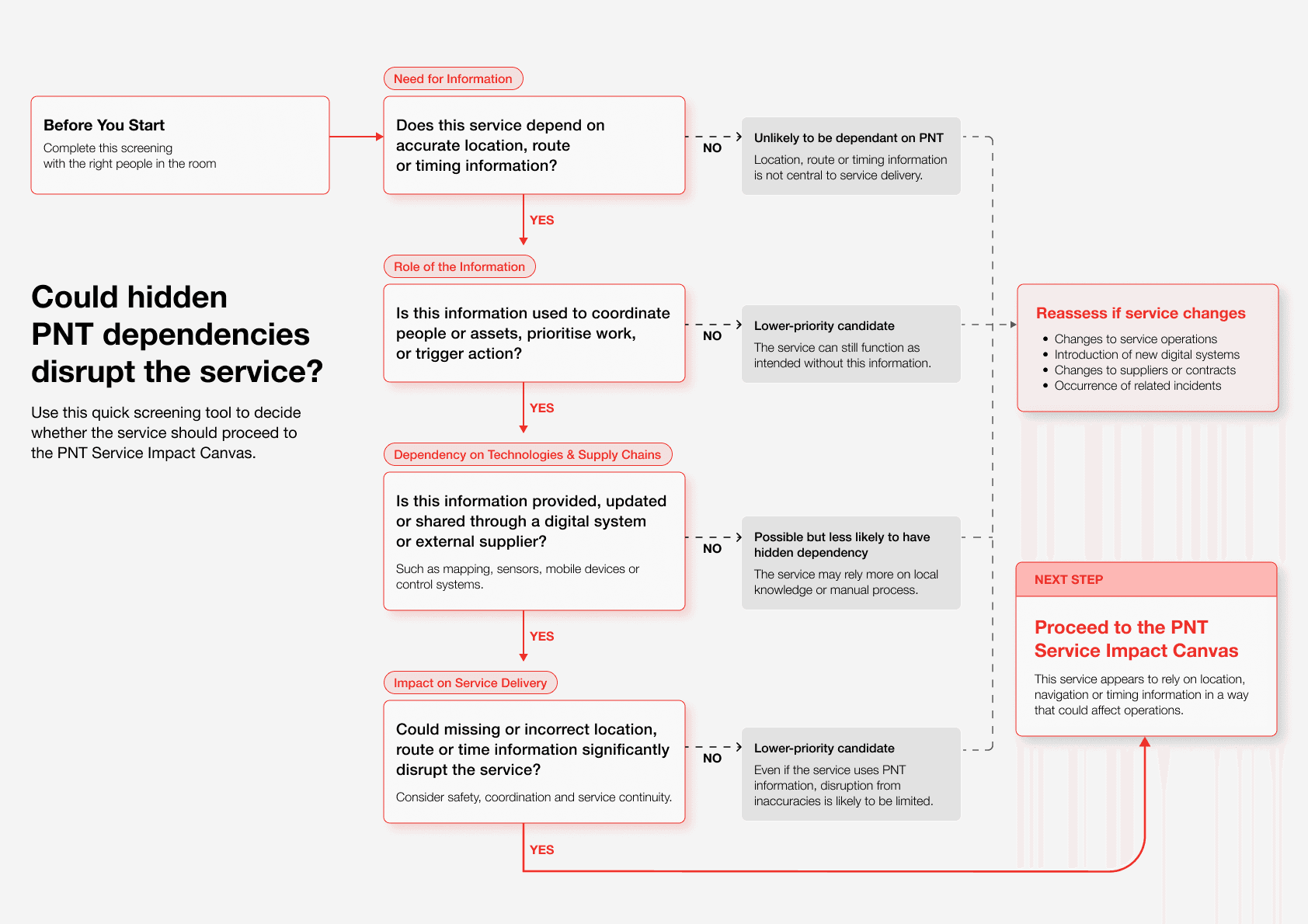
Artefact 1 — Screening Tool
PNT Dependency Check
Identify potential PNT reliance before further assessment
The tool provides a short, sequential guide across four questions, helping users consider potential PNT dependencies and determine the most appropriate next step for each service.
Artefact 2 — Facilitated Framework
PNT Service Impact Canvas
Explore how PNT failure could affect service delivery
The question set was developed by analysing the RIN Resilient PNT Checklist and tailoring its underlying logic — dependency, confidence, consequence, ownership — into plain-language,
scenario-led prompts that don't assume prior GNSS knowledge.


Implementation Strategy
Rather than build a new PNT governance layer,
the toolkit routes evidence through the structure local authorities already trust: Local Resilience Forums.
The project sits at the delivery tier, but is designed to send local insight upward, through LRF coordination and sector learning, into national policy and investment, while national guidance gives local action greater legitimacy in return.

Expected Outcome
This Toolkit gives local authorities a starting point before disruption forces the issue.
Shared with the National PNT Office at both the start and end of development, it's proposed as a first step within existing risk and resilience processes, not a replacement for them.

Lesson Learned
Made visible in their own terms
The biggest lesson wasn't technical, it was about making an invisible risk feel relevant. PNT dependency was real, but nobody felt it, so the project only moved once I stopped explaining PNT as a specialist risk and started framing it through service delivery, the language local authorities already used to justify their time and budget.
That shift changed how I built every artefact after it. The Screening Tool's four questions and the Canvas's plain-language prompts weren't simplified versions of the RIN Checklist, they were translations of its underlying logic into a vocabulary a non-specialist could actually act on. I learned that communication in service design isn't about clarity for its own sake, it's about finding the point where a stakeholder's existing priorities and the problem you're introducing actually meet.